Russia Su-33 "Flanker-D" fighter

Russia Su-33 "Flanker-D" fighter

It is a single-seat two-fire all-weather carrier-based multi-function fighter developed by the Russian Sukhoi Design Bureau based on Su-27. Designed for the Russian Navy to meet the operational needs of aircraft carriers, it has enhanced landing gear and structure, as well as folding wings to adapt to carrier-based operations. It first flew in May 1985 and entered service in 1994. The design includes increased duckwings and increased wing area for improved lift and maneuverability. The folding design of its wings and tail reduces the area occupied on the aircraft carrier deck and increases the aircraft capacity on the deck. It is an important part of the Russian naval aviation,
Soviet Su-27P "Flanker-B" fighter

Soviet Su-27P "Flanker-B" fighter

It is a single-seat dual-engine all-weather air superiority heavy fighter developed by the Soviet Union's Sukhoi Design Bureau, and belongs to the third-generation fighter. It is the early production model of the Su-27 series, and its main tasks are territorial air defense, escort, and maritime patrol. Using the wing-body fusion technology, the cantilever type has a single wing, a smooth curved forward wing outside the wing root, a normal layout of double vertical tails, and a wedge-shaped inlet located at the front and lower part of the wing-body fusion, with good aerodynamic performance. Although gradually replaced by more advanced fighters over time, it still has an important place in aviation history and is an iconic aircraft in the history of Soviet military aviation.
Russian Su-30 fighter

Russian Su-30 fighter

It is a two-seater, two-engine multi-purpose fighter developed by the Russian Sukhoi Design Bureau based on the Su-27 fighter. The NATO code name is "Flanker-C". It first flew on December 31, 1989 and was designed to meet the needs of modern air combat with outstanding air-to-air and air-to-ground combat capabilities. The design emphasized maneuverability and versatility, adopted a swept-wing layout, and was equipped with two AL-31F turbofan engines. Since its service, it has been procured by several countries and has become an important part of the modern air force. Its design and performance make it excellent and adaptable in a variety of combat tasks.
Russian Su-47 "Berkut" fighter

Russian Su-47 "Berkut" fighter

It is a supersonic fighter developed by the Russian Sukhoi Design Bureau and first flew in September 1997. The design goal is to be a next-generation fighter with ultra-maneuverability and stealth capabilities, designed to replace Soviet-era fighters and meet the needs of modern air combat. The most notable feature is its forward-swept wing design, which is similar to the American X-29 test machine and can provide a higher lift-to-drag ratio and better maneuverability. Significant progress has been made in technology, but due to the inability to meet the specific needs of the Russian military, it finally failed to enter mass production. But it marks Russia's innovation and development in the field of fighter design.
American F-4PhantomII fighter

American F-4PhantomII fighter

It is a two-seater two-engine all-weather long-range supersonic air defense interceptor or fighter bomber developed by MacDonald Aircraft Company (now Boeing) in the late 1950 s. Originally designed for the U.S. Navy, it was later adopted by the U.S. Air Force and Marine Corps and became a common fighter for the U.S. Navy and Air Force. Known for its superior flight performance, firepower and multi-purpose capabilities, it participated in many conflicts such as the Vietnam War and the Middle East War, and became a symbol of Western air power during the Cold War. It is one of the most produced supersonic military aircraft in the history of the United States, with a total of 5068 aircraft produced, affecting the military aviation power of many countries.
American YF-23BlackWidowII fighter

American YF-23BlackWidowII fighter

It is an advanced stealth air superiority fighter jointly developed by Northrop/McDonnellDouglas. It participated in the competition of the advanced tactical fighter program of the US Air Force, competed with Lockheed's YF-22 prototype, and finally YF-22 won and became the F-22Raptor. It stands out for its unique design and advanced characteristics. Although it failed to win the contract, its design and technological innovation have had an impact on subsequent aircraft development. Design features include a diamond-shaped airfoil and a unique V-shaped tail, which contribute to its stealth capabilities.
American F-16 FightingFalcon fighter

American F-16 FightingFalcon fighter

It is a single-engine multi-role fighter developed by General Dynamics (now Lockheed Martin) in the 1970 s to provide a lightweight, high-performance air superiority and ground attack platform. It is one of the representatives of the fourth-generation fighter, known for its high thrust-to-weight ratio, maneuverability, advanced avionics and relatively low maintenance costs. With a single vertical tail and bubble canopy, it provides the pilot with an excellent all-round view. Participated in numerous conflicts and wars, including the Gulf War, the Kosovo War and the Iraq War, proving its effectiveness on the modern battlefield.
Soviet Yak-141 "Freestyle" fighter (hay fan color)

Soviet Yak-141 "Freestyle" fighter (hay fan color)

It is a supersonic vertical/short-range take-off and landing fighter developed by the Yakovlev Design Bureau of the Soviet Union. It was designed to be a carrier-based fighter of the Soviet Navy. It made its first flight on March 9, 1987 and was in Farnborough in 1992. Public appearance at the Luke Air Show. It is considered a major leap forward in Soviet aviation technology. Its design requirements include supersonic flight, advanced fire control systems, radar/sensor packages, greater combat range, and diversified weapon options. However, due to funding problems after the collapse of the Soviet Union, the project was eventually terminated in 1992, although it was still an important milestone in the history of Soviet aviation.
Soviet Yak-141 "Freestyle" fighter

Soviet Yak-141 "Freestyle" fighter

It is a supersonic vertical/short-range take-off and landing fighter developed by the Yakovlev Design Bureau of the Soviet Union. It was designed to be a carrier-based fighter of the Soviet Navy. It made its first flight on March 9, 1987 and was in Farnborough in 1992. Public appearance at the Luke Air Show. It is considered a major leap forward in Soviet aviation technology. Its design requirements include supersonic flight, advanced fire control systems, radar/sensor packages, greater combat range, and diversified weapon options. However, due to funding problems after the collapse of the Soviet Union, the project was eventually terminated in 1992, although it was still an important milestone in the history of Soviet aviation.
Soviet Su-27 "Flanker-B" fighter

Soviet Su-27 "Flanker-B" fighter

It is a heavy multi-role fighter developed by the Soviet Sukhoi Design Bureau in the 1970 s to compete with the American F-15 "Eagle. Served in 1985 and became one of the main fighters of the Soviet Air Force. The design emphasizes air superiority, with excellent maneuverability and long range, suitable for performing multiple tasks. The design made it an important air power during the Cold War and served in the air forces of many countries, including China, India and Ukraine. Over time, the Su-27 series has also spawned a variety of improved and export models that continue to play a role in modern air combat.
European EurofighterTyphoon Fighter

European EurofighterTyphoon Fighter

It is a dual-engine, delta-wing, multi-purpose fighter developed by European multinational cooperation. It was originally designed as an air superiority fighter. The Future Eurofighter program, which began in 1983, is a multinational collaboration between Britain, Germany, France, Italy and Spain. Due to disagreements over design and operational requirements, France left the consortium and independently developed the Dassault Rafale fighter. The first flight took place on March 27, 1994, and was officially commissioned on August 4, 2003. The design and capabilities make it the cutting edge of modern fighter technology and represent the result of a collaboration between the European military aviation industry.
Swedish Saab35Draken Fighter

Swedish Saab35Draken Fighter

It is a supersonic fighter designed and manufactured by the Swedish Saab company in the 1950 s. It is the first supersonic aircraft of the Swedish Air Force and the first mass-produced dual-delta aircraft in the world. Draken means "dragon" or "kite" in Swedish. Its design features a double delta wing layout, with an inner wing leading edge sweep angle of 80 ° and an outer wing leading edge sweep angle of 57 °. This design provides good performance at both high and low speeds. He served in the Swedish Air Force for many years until his official retirement in 1999. The design and performance made it an important Nordic air defense force during the Cold War.
Russian Su-57 "Felon" fighter (gray)

Russian Su-57 "Felon" fighter (gray)

It is the fifth-generation twin-firing stealth multi-purpose fighter developed by the Russian Sukhoi Design Bureau. It is Russia's first military aircraft using stealth technology. Designed to perform air superiority and attack missions, its development began in 2002, with its first flight on 29 January 2010. Designed to have supersonic cruise capability, long battle radius, low radar cross-sectional area, super maneuverability and short take-off and landing (STOL) characteristics, while maintaining a large ground attack capability. The design includes a fusion wing-body fuselage, full-motion horizontal and vertical stabilization surfaces, with thrust vector and adjustable leading edge vortex controller to improve high angle-of-attack behavior and allow rapid stall recovery
Russia Su-57 "Felon" fighter

Russia Su-57 "Felon" fighter

It is the fifth-generation twin-firing stealth multi-purpose fighter developed by the Russian Sukhoi Design Bureau. It is Russia's first military aircraft using stealth technology. Designed to perform air superiority and attack missions, its development began in 2002, with its first flight on 29 January 2010. Designed to have supersonic cruise capability, long battle radius, low radar cross-sectional area, super maneuverability and short take-off and landing (STOL) characteristics, while maintaining a large ground attack capability. The design includes a fusion wing-body fuselage, full-motion horizontal and vertical stabilization surfaces, with thrust vector and adjustable leading edge vortex controller to improve high angle-of-attack behavior and allow rapid stall recovery
Russian MiG-35 multi-role fighter (gray)

Russian MiG-35 multi-role fighter (gray)

It is a 4-generation multi-purpose fighter developed by the Russian MiG Aircraft Group. Based on MiG-29M/M2 and MiG-29K/KUB technologies, it has improved flight performance, advanced avionics equipment and diversified precision guided weapons. The aerodynamic layout adopts a design that relaxes the longitudinal static stability, and is equipped with a three-channel four-redundant digital line flight control system and a larger thrust engine to improve maneuverability. Increased internal and external fuel loads and aerial refueling capabilities significantly increase range. Reduced radar and infrared signatures, equipped with the latest self-defense kits and redundant aircraft systems, improve survivability
Soviet MiG-23MLD "Flogger" fighter

Soviet MiG-23MLD "Flogger" fighter

It is a variable swept wing fighter developed by the Soviet MiKoyan Design Bureau in the 1970 s. It is an improved model in the MiG-23 series. The design goal is to improve the high-altitude high-speed interception capability and ground attack performance. A single-seat variable-swept-wing aerodynamic layout is used, with a turbojet engine installed, and the speed can reach Mach 2.35 at high altitude. Its horizontal acceleration is good, which is conducive to low-altitude penetration, high-speed interception and detachment after attack. Served in the air forces of the Soviet Union and its allied countries and proved his strength in numerous conflicts. Despite its technological backwardness, it remains a symbol of an era.
Russian MiG-31K fighter model

Russian MiG-31K fighter model

It is an improved model developed by Russia's MiGaoyan Design Bureau on the basis of MiG-31, specially designed to carry hypersonic missiles. It inherits the high-speed and high-altitude flight characteristics of the MiG-31, while adding new avionics and weapon systems. Capable of carrying the Kh-47M2 "dagger" air-launched hypersonic missile, this missile claims to have a range of 2000 kilometers and a speed of Mach 10, and can break through the US missile defense system. This capability enables it to perform not only traditional interception missions, but also strategic strike missions. It is a key long-range interception and strategic strike platform in the Russian Air Force.
Soviet MiG-29 "Fulcrum" fighter (gray)

Soviet MiG-29 "Fulcrum" fighter (gray)

It is a fourth-generation jet fighter developed by the Soviet Miaoyan Design Bureau in the 1970 s and was designed to replace earlier models such as the MiG-21 and MiG-23. Known for its excellent maneuverability and high-speed performance, it is the main aircraft of the Soviet Air Force and the air forces of many other countries. The design focuses on air superiority and multi-purpose capabilities, capable of performing tasks in day, night and complex weather conditions. The aerodynamic design includes a wing-to-body fusion body, a large wing and a double vertical tail, which provide excellent lift and maneuverability. The power system is provided by two Klimov RD-33 afterburner turbofan engines.
Russian MiG-31 "Foxhound" interceptor (gray)

Russian MiG-31 "Foxhound" interceptor (gray)

It is a Soviet/Russian tandem two-seater all-weather interception fighter designed by Mikoyan and Gleevich Design Bureau. It was developed to replace the MiG-25 "Foxbat" and was designed to intercept high-speed, high-altitude targets. It first flew in 1975 and entered service in 1983. It has an upper single wing, double vertical tail and air intake layout on both sides, with a captain of 22.69 meters, a wingspan of 13.46 meters and a height of 6.15 meters. It is equipped with two D-306 afterburner turbofan engines. Known for its high speed, long range, large bomb load and strong interception capability, it is still one of the main fighters of the Russian Air Force.
Russian MiG-35 fighter

Russian MiG-35 fighter

NATO code name: "Fulcrum-F" is a four-and-a-half-generation multi-purpose fighter developed by Russia's Mikoyan Design Bureau on the basis of MiG -29M/M2 and MiG -29K/KUB technologies (according to the US-Russian fighter generation standard). It made its public debut in 2007 and entered service with the Russian Air Force in 2019. The design goal is to improve the handling performance, expand the use and enhance the combat effect. Its maximum take-off weight is 30% higher than that of the MiG -29M2, so it is classified as a medium-weight fighter. The model is being introduced to the international market.
Russian MiG1.42MFI multi-role front-line fighter
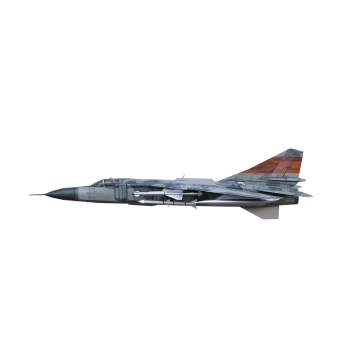
Russian MiG1.42MFI multi-role front-line fighter

It is a technology demonstrator developed by Russia in the early 1990 s to demonstrate the technology of the next generation of fighter jets. The design has stealth characteristics, adopts variable geometry air inlet and advanced avionics system, including NIP-NO14 phase array controlled pulse Doppler radar and rear-view self-defense radar. The shape was designed with invisibility in mind, although Western observers were skeptical. It was not put into production due to economic problems and the high cost of the project. Nevertheless, the technical demonstration provided valuable experience for the Russian aviation industry and influenced subsequent fighter design.
Soviet MiG-23 "Flogger" multi-role fighter (gray-blue fan color)

Soviet MiG-23 "Flogger" multi-role fighter (gray-blue fan color)

It is a multi-purpose fighter developed by the Soviet Union in the late 1960 s and designed by the Mikoyan-Gleevich Design Bureau. It debuted in 1970 and served in the air forces of the Soviet Union and its allies for the next few decades. The design goal is to find a balance between high speed and high maneuverability. It has a variable sweep wing design, which can adjust the wing sweep angle under different flight conditions to adapt to different mission requirements. As a multi-role fighter, the main uses include air superiority combat, ground attack and tactical reconnaissance, and can carry a variety of weapons.
Soviet MiG-23 "Flogger" multi-role fighter (dark green fan color)

Soviet MiG-23 "Flogger" multi-role fighter (dark green fan color)

It is a multi-purpose fighter developed by the Soviet Union in the late 1960 s and designed by the Mikoyan-Gleevich Design Bureau. It debuted in 1970 and served in the air forces of the Soviet Union and its allies for the next few decades. The design goal is to find a balance between high speed and high maneuverability. It has a variable sweep wing design, which can adjust the wing sweep angle under different flight conditions to adapt to different mission requirements. As a multi-role fighter, the main uses include air superiority combat, ground attack and tactical reconnaissance, and can carry a variety of weapons.
Soviet MiG-23 "Flogger" multi-role fighter (fan color)

Soviet MiG-23 "Flogger" multi-role fighter (fan color)

It is a multi-purpose fighter developed by the Soviet Union in the late 1960 s and designed by the Mikoyan-Gleevich Design Bureau. It debuted in 1970 and served in the air forces of the Soviet Union and its allies for the next few decades. The design goal is to find a balance between high speed and high maneuverability. It has a variable sweep wing design, which can adjust the wing sweep angle under different flight conditions to adapt to different mission requirements. As a multi-role fighter, the main uses include air superiority combat, ground attack and tactical reconnaissance, and can carry a variety of weapons.